
The ChatGPT Telehealth Index Owns Your Brand. Here's What to Do About It.
IntroductionYour telehealth company doesn't show up when patients ask ChatGPT who can treat their acne or prescribe birth control online. Instead, they get Nurx and Ro, every time. Across 15 answer sets, Nurx took the top slot in 6 and Ro in 5, while 25 different companies fought over the scraps.
That gap comes down to a visible, auditable trust architecture the big brands built and most smaller shops never started. AI doesn't ignore you.
You never gave it anything structured, verifiable, and citable to find. This article maps a seven-step fix, from directories and schema to the therapy category where picks rotate every run, so you can stop being invisible and start occupying the answer block.
Key Takeaways
Every recommendation engine that matters runs on the same blunt logic: cite what looks credible, authoritative, and machine-readable. If you get these seven mechanics right, you break into the pool of brands ChatGPT, Perplexity, and AI Mode actually name, without outspending the incumbents.
- Directories are the table stakes: Healthgrades, Zocdoc, and WebMD supplied most ChatGPT citations. You do not appear unless you are listed, consistent, and schema-tagged.
- Structured data is a non-negotiable signal: MedicalOrganization and Physician markup plus FAQ schema determine whether AI can parse and cite your content.
- Category-specific authority pages matter: A dedicated ADHD treatment page with the treating clinicians named always outperforms a generic clinic overview.
- Therapy is an open lane: Unlike acne or birth control, online therapy recommendations changed every run in testing, with no single brand owning the answer.
- Off-site footprint multiplies your weight: Reviews, press mentions, and directory listings across third-party sites build the external citation volume AI uses as a proxy for authority.
Step 1: Map the AI Discovery Landscape, Directories, Profiles, and Structured Data

AI assistants do not browse your homepage and decide. They search. In a panel of 40 answers, ChatGPT cited a directory or review platform in 65% of answers, while Perplexity reached 80%. Those searches hit Healthgrades, Zocdoc, WebMD, and similar aggregators before they ever touch your site. If your practice is missing from those sources, you are not in the citation pool.
- Claim and standardize your directory listings: Ensure your name, address, phone, and specialty match exactly across Healthgrades, Zocdoc, WebMD, Vitals, and RateMDs. A mismatch creates a split entity in the knowledge graph, and AI won't bridge it.
- Add MedicalOrganization and Physician schema to every location and provider page: This markup tells crawlers what you are, where you practice, and what you treat. Without it, you remain untyped text.
- Validate each page with Schema.org's validator. A single error can invalidate the entire block, so test every URL.
- Feed the underlying source: Many directories pull from the NPI Registry. The registry itself didn't appear in any test answer, but a clean, complete NPPES record helps your data propagate correctly across aggregators.
Step 2: Build Trust Signals That AI and Patients Can Verify
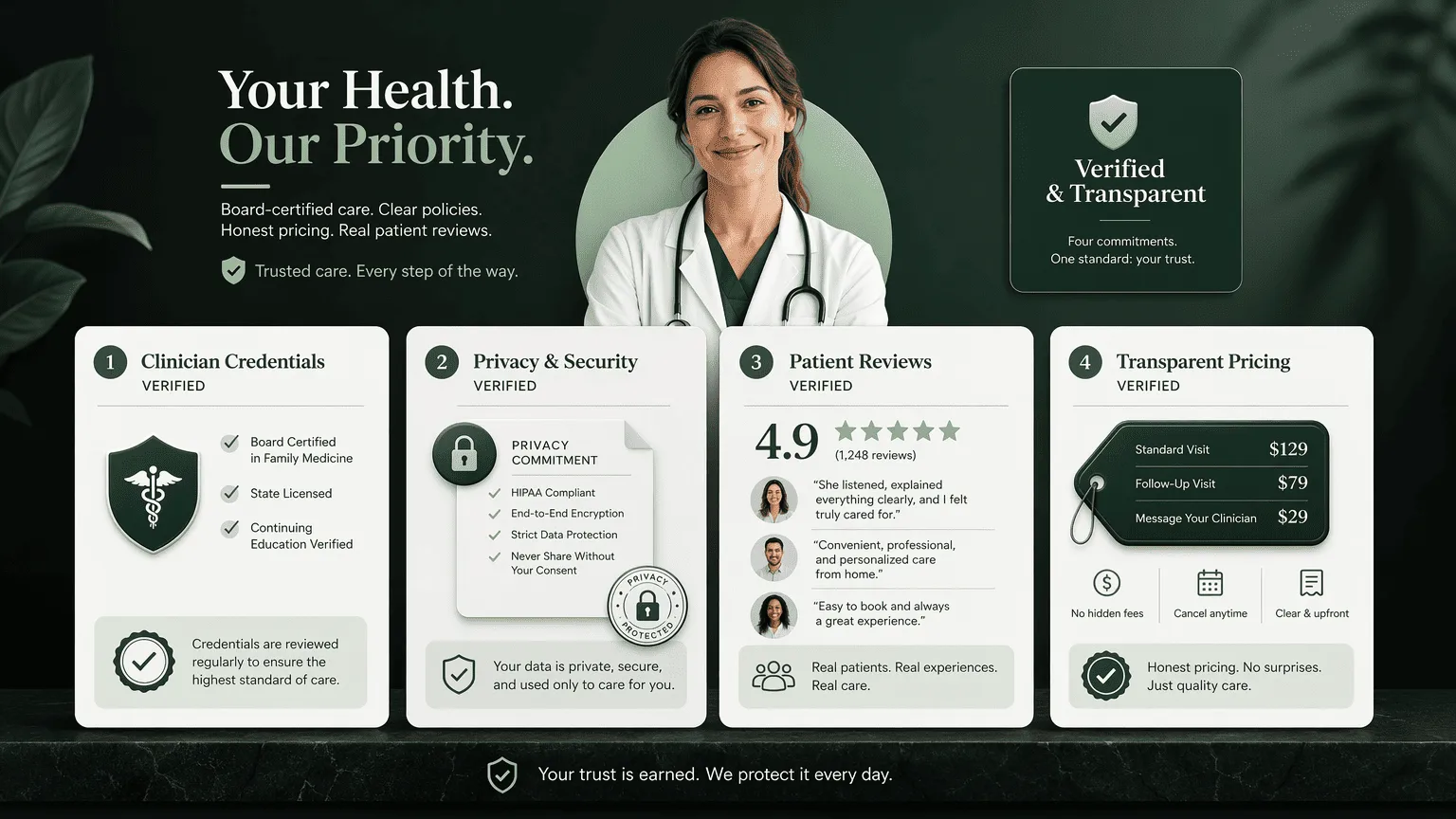
The engine parses these signals from the plain text and structured data you publish. The big brands make them dead obvious. Most smaller brands bury them or never post them at all. You can outspend Nurx on ads (you will not) or you can match their on-page trust depth for a few hours of content work.
| Trust Signal | What AI Evaluates | Implementation |
|---|---|---|
| Clinician Credentials | Board certifications, state licenses, years of practice | Publish a dedicated bio page per provider with full credentials in plain text and schema markup; include NPI numbers where permitted and link to state license verification pages |
| Transparent Pricing | Exact cash-pay prices, insurance acceptance, sliding-scale details | Publish a public pricing page with dollar figures, not 'affordable' or 'competitive'; structure with Product schema where applicable |
| Privacy & Compliance | HIPAA policy, data handling, audit history | Post a plainly worded privacy policy that names your security framework and third-party audits; do not hide it in legalese |
In the October 2026 tests, answers cited Nurx with direct links to its pill and patch pages, not its homepage. The engine reads your site page by page, searching for the closest match to the query's treatment and credential intent.
You compete by creating a dedicated, structurally identical page for every service you offer. That cluster signals topical depth. Clustered content earns 30% more organic traffic than unclustered content and keeps rankings longer. One thin 'services' page with ten bullet points does the opposite.
Entity optimization ties it together. Link each condition page to the specific doctors who treat it, each doctor to their board certifications, and each medication to its prescribing protocol. That graph of relationships, expressed in internal links and schema, mirrors the knowledge graph AI uses. A page that says 'we treat acne' is noise.
Step 4: Create Authority Content That Answers What AI Looks For
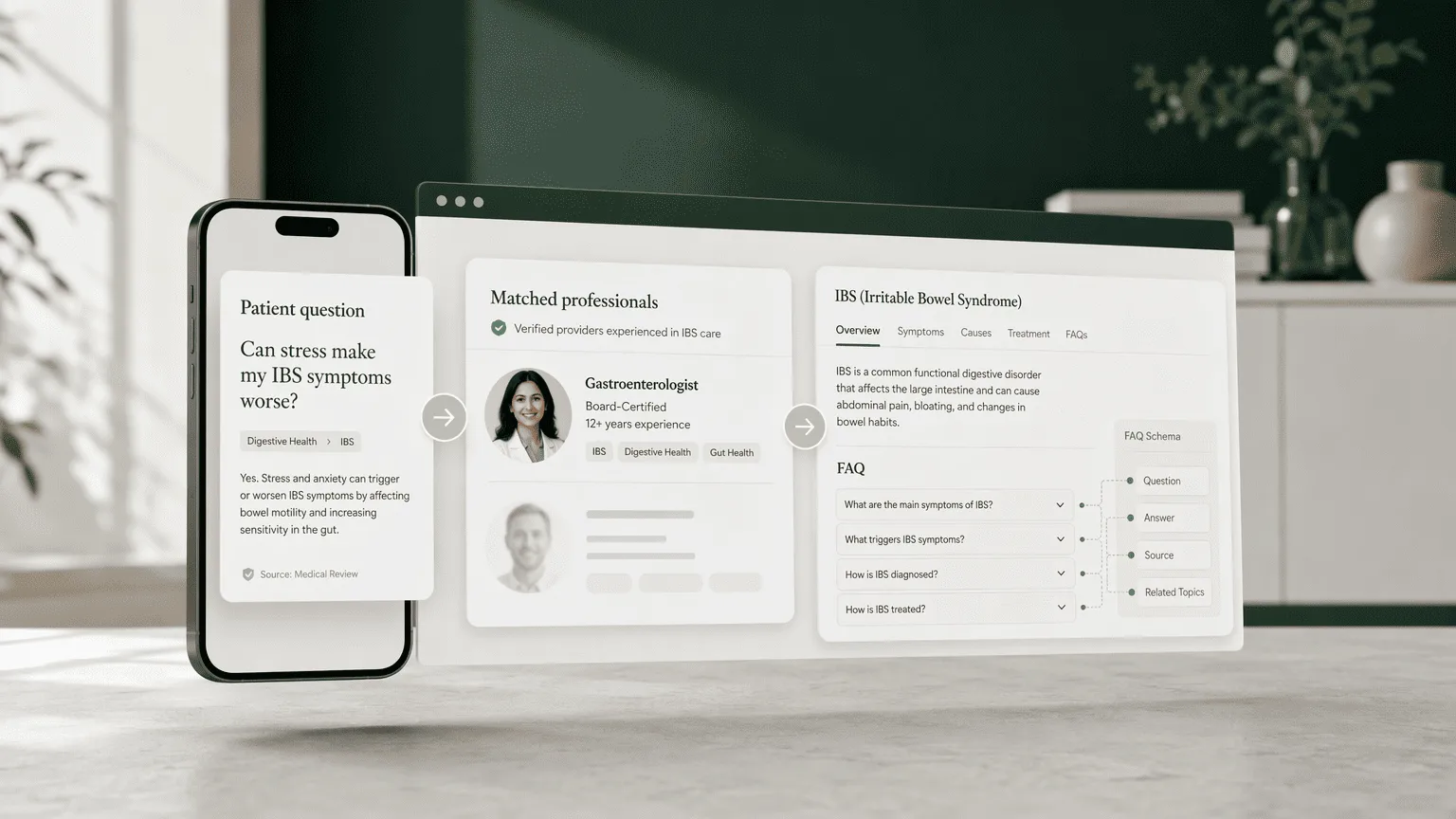
In 38 of 40 answers, ChatGPT restricted at least one background search to a directory or professional society. That means your content has to be findable through those directories, and when it is found, it has to match the question. The format that wins is Q&A.
Write an FAQ page for every condition and treatment, then mark it up with FAQ schema. When a patient asks 'can I get birth control online without a doctor visit', ChatGPT searches directories for providers, then scans their sites for that exact question and a structured answer. If you have an FAQ block with that question and a concise, physician-reviewed answer, you become the cite.
Pillar pages anchor this. A 2,000 to 5,000-word guide on 'online birth control' divided into short sections, with a table of contents and jump links, signals thorough authority. It attracts backlinks from health blogs and press mentions, which in turn feed the off-site citation counts AI monitors.
A broken schema is worse than none: if your FAQ markup doesn't match the visible text exactly, search engines may strip your rich results. Test every page with Google's Rich Results tool before going live. Educational content converts beyond rankings: educational content generates 42% more patient appointments than promotional messaging alone.
But here, the primary objective is not a conversion. It is a citation. Write to be quoted, not to sell.
Quote credible sources, link to primary research, and attribute every medical claim. An AI engine will cite the most authoritative version of an answer it finds, and authority is earned by citing others well.
Step 5: Strengthen Your Off-Site Footprint, Get Listed, Get Reviewed, Get Press
Directory citations do more than put you on a map. In the October 2026 panel, the share of directory citations among AI-answer domains varied from 7% for Gemini to 34% for ChatGPT. Perplexity cited directories in 80% of answers. If your brand lacks complete profiles with reviews across the top directories, you are invisible to two of the three most prolific AI recommenders.
Listings alone are not enough. Reviews matter. A profile with 200 reviews and an average 4.8 rating signals stability and patient volume.
Both are proxies for trust that AI engines interpret as low-risk recommendation targets. You cannot fake volume, but you can systematize it.
Automate post-consultation review prompts through the EHR. Target Healthgrades first, then Zocdoc, then Google.
Press is the missing multiplier. When a major health publication cites your study or quotes your clinician, that page becomes a high-authority backlink in the citation graph AI traverses. Pitch journalists with data, not press releases.
A survey of 500 patients on telehealth wait times, conducted with academic rigor, gets coverage. "We are excited to announce our new platform" does not.
Press citations feed the entity authority that separates big brands from invisible ones. The difference between a Nurx and an unknown is thousands of external references reinforcing the same entity to every AI crawler.
If you are starting now, allocate 20% of your marketing hours to reputation and press, even before you run ads. A practice with 50 reviews and two media mentions will outrank a practice with zero reviews and a $5,000 monthly ad spend in AI recommendations every time. The signal AI cares about is third-party verification, not self-reported claims.
Step 6: Target the Open Category, Why Therapy Is Your Fastest Path to AI Mentions

Therapy is the one category where ChatGPT does not have a default answer. In three runs for online therapy, it picked a different top provider every time, and it mentioned BetterHelp only to warn about its FTC privacy settlement. That instability is a wide-open window for a smaller brand with clean privacy posture and structured content to dominate the recommendation slot.
The playbook is narrow and fast. Build a dedicated therapy pillar page with sub-pages for each modality: CBT, EMDR, couples counseling. Embed FAQ schema with questions about cost, credential verification, and session format. Publish plain-English privacy policy language that explicitly addresses data handling and third-party sharing, mirroring the exact language that Google and ChatGPT parse.
Then press distribution. Pitch therapy comparison pieces to health and wellness publications. Offer free clinician Q&As to journalists covering mental health access.
Every citation builds the entity trail. The category is open now, but a brand that closes the loop on trust signals and directory consistency can lock it down within 12 months. The short answer: move now, lead with privacy as a differentiator, and own the structured answer before BetterHelp fixes its reputation gap.
Step 7: Implement and Test Technical SEO for AI Visibility

AI engines ignore sites they can't crawl quickly, sites that break on mobile, and sites with invalid schema. Most telehealth sites fail at least one of those, and the cost is a completely invisible practice. Open Google Search Console, check the coverage report for crawl errors, confirm every important page is indexed, and verify that your schema validates without warnings.
Page speed affects Google rankings directly and matters for AI bots indirectly. When a treatment page takes six seconds to load, the bot times out before it reads your schema. Compress images, defer third-party scripts, serve content through a CDN. Test on real phones, not just in the Chrome DevTools emulator. Mobile-first indexing treats your mobile page as the only page, so desktop and mobile must have the same content, the same schema, and the same links.
Run your key service pages through a crawler that mimics Perplexity or ChatGPT. Confirm every piece of structured data sits in the raw HTML source. Position-1 organic CTR fell from 28% to 19% year over year as AI Overviews absorbed clicks, but the pages cited inside AI Overviews earn roughly 120% more clicks per impression than uncited pages. Technical SEO is the bid for that slot. Check your branded queries every week on Google and ChatGPT, and fix missing or wrong citations the day you spot them.
Conclusion
The AI recommendation lane is not closed. It is gated by trust signals, structured data, and off-site citation weight, all assets you can build without a Nurx-size war chest. Therapy offers the fastest path to visibility, and the directory, schema, and content steps apply universally.
Start with Step 1 this week: audit and unify your directory listings. Want to see what your first month of ClinAds creative would look like? Book a 30-minute intro call.
Frequently Asked Questions
What factors does ChatGPT consider when recommending telehealth providers?
In testing, it also leaned heavily on directory listings from platforms like Healthgrades, Zocdoc, and WebMD, and it cited practice websites that directly answered specific treatment and credential queries with structured content.
How can a smaller telehealth company improve its online visibility and brand authority?
Earning patient reviews, securing press mentions, and building educational content that answers common patient questions with cited sources further strengthens authority.
What role do structured data and entity optimization play in being recommended by AI answer engines?
Structured data and entity optimization make your content machine-readable, allowing AI engines to parse your services, providers, and trust signals unambiguously. Implementing schema types like FAQ, MedicalOrganization, and Physician, and linking entities through internal links and schema, directly increases the likelihood of being cited as a relevant, authoritative source.
What are the key differences in digital marketing strategies between large telehealth brands and smaller players?
Large brands have years of accumulated reviews, press, and directory citations, creating dense off-site authority. Smaller players cannot match that volume immediately but can close the gap by focusing on category-specific content, earning targeted press, systematizing review collection, and leveraging open categories like therapy where big brands have reputation vulnerabilities or inconsistent AI recommendations.
What specific SEO and content strategies help smaller telehealth companies get mentioned by AI models like ChatGPT?
Specific strategies include building FAQ pages with schema markup, creating pillar-and-cluster content around treatments, optimizing for treatment-first long-tail queries that mention credentials, and publishing transparent pricing. A strong off-site footprint of reviews and press mentions, combined with technically sound schema-audited pages, positions a smaller brand to be cited alongside dominant competitors.
Sources
- SEO Clusters for Telehealth: Build Authority with a Pillar-and-Cluster Strategy - bask.health
- Telehealth SEO: 10 Tactics to Rank a Virtual-Care Practice - www.trypropel.ai
- Which Telehealth Companies ChatGPT Recommends | Hacker House - monicahacker.com
Want help executing this for your clinic?
Book a 30-minute call and we will map what a real ad engine would look like for your specific service mix.
Book a call