
Telehealth Marketing Agency in the US: The Complete 2026 Guide
IntroductionYour telehealth brand isn't growing because your marketing agency treats HIPAA like an afterthought. The problem isn't your clinical team, your platform, or even your budget. It's that most agencies build campaigns on a foundation of tracking pixels, third-party cookies, and consent banners that mean nothing under federal law. That setup was barely functional before the American Hospital Association v. Becerra ruling in June 2024. Now it's a liability that exposes your practice to fines and destroys the attribution data you rely on to scale.
Telehealth utilization has stabilized at roughly 38 times pre-pandemic levels, and the market continues to fragment across DTC pharmacy brands, hybrid click-and-mortar providers, and health systems treating virtual care as a core access point. The channel is not broken. The brief is.
What follows is a diagnostic for operators who need an agency that understands the regulatory environment, builds measurement frameworks that survive legal scrutiny, and drives predictable patient acquisition without betting your compliance posture on wishful thinking.
Key Takeaways
The right agency decision changes your unit economics. The wrong one generates leads you can't attribute and exposes your practice to regulatory risk. Here is what every operator needs to know before signing:
- Specialized agencies deliver a 3:1 to 8:1 ROI: top performers use brand storytelling for stigmatized conditions and localized SEO for hybrid models. Sweat Pants Agency reported a 9x revenue increase over 30 days for TrimRx, showing what focused execution can do (self-reported, unverified).
- Monthly retainers range from $5,000 to $25,000+: project fees for website builds or campaigns are separate; what you get at each tier is a function of healthcare experience, not generic marketing deliverables.
- Agencies must cover SEO, paid media, content, and web: point solutions won't sustain full-funnel growth for virtual-first or DTC models, reputation management and analytics infrastructure separate winners from the rest.
- 2026 trends shift to AI, video, and privacy-safe measurement: AI-driven personalization and post-Becerra attribution models are what the smart money is building now.
What a Telehealth Marketing Agency Actually Does

A specialized telehealth marketing agency builds and runs the growth infrastructure that turns website visitors into scheduled visits, repeat patients, and durable relationships, not just leads. Telehealth success is measured in scheduled visits, efficient acquisition, repeat use, and durable patient relationships. That definition shapes every service line, from search to content to reputation management.
Agencies like Healthcare Success handle SEO, paid search, paid social, landing pages, and analytics for DTC telehealth platforms, hybrid click-and-mortar brands, and health systems. They also manage reputation and review strategies that change the patient acquisition cost math. For providers with an online pharmacy or DTC Rx component, the agency folds that into the broader telehealth strategy, often through a dedicated pharmacy marketing program.
A general healthcare marketing firm isn't the same as a telehealth specialist. The specialist designs the entire funnel around virtual-first patient flows, from initial search to asynchronous follow-up. They understand that the treatment modality shapes the conversion event.
The trade-off: some shops are strong on paid media but weak on content, while others excel at SEO and cannot execute paid social within HIPAA constraints. You need full-funnel coverage, not a disconnected set of point solutions that leave gaps in the patient journey.
The HIPAA-Privacy-By-Design Framework for Campaigns

The June 2024 American Hospital Association v. Becerra ruling vacated only the 'Proscribed Combination' portion of HHS tracking guidance, the part that said IP addresses on unauthenticated public pages about conditions or providers required patient authorization. The core prohibitions remain. You still cannot deploy advertising pixels on logged-in pages, patient portals, telehealth platforms, appointment booking tools, or symptom checker applications. Cookie banners are not valid HIPAA authorizations, and vendors promising to strip health data after receipt do not insulate your practice.
Business associate agreements (BAAs) are non-negotiable for any vendor that touches protected health information. A pixel on a medication page, a 'find a provider' lookup, or a telehealth login can capture identifiers that meet the legal threshold for PHI. If that data flows to Meta or Google without a BAA, the marketing campaign is a compliance incident. Standard pixel implementations on telehealth sites leak protected health information, the leakage is not theoretical. Hospitals and health systems have been named in Wiretap Act class actions and FTC enforcement for this exact configuration, and telehealth brands with high patient volumes are the next obvious target.
The practical implication: your agency must operate server-side conversion APIs, privacy-compliant attribution models, and zero-pixel measurement stacks where necessary. If your agency's first instinct is to drop a Facebook pixel in your GTM container and call it tracking, you have the wrong partner. Off-the-shelf retargeting audiences built on health-sensitive page views are no longer safe, and the performance data you lose in a privacy-safe setup can often be reconstructed through first-party data capture, incrementality testing, and media mix modeling that doesn't depend on per-click identifiers.
That is the gap a compliant agency fills: measurement without exposure, scale without surveillance.
How Much Telehealth Marketing Really Costs
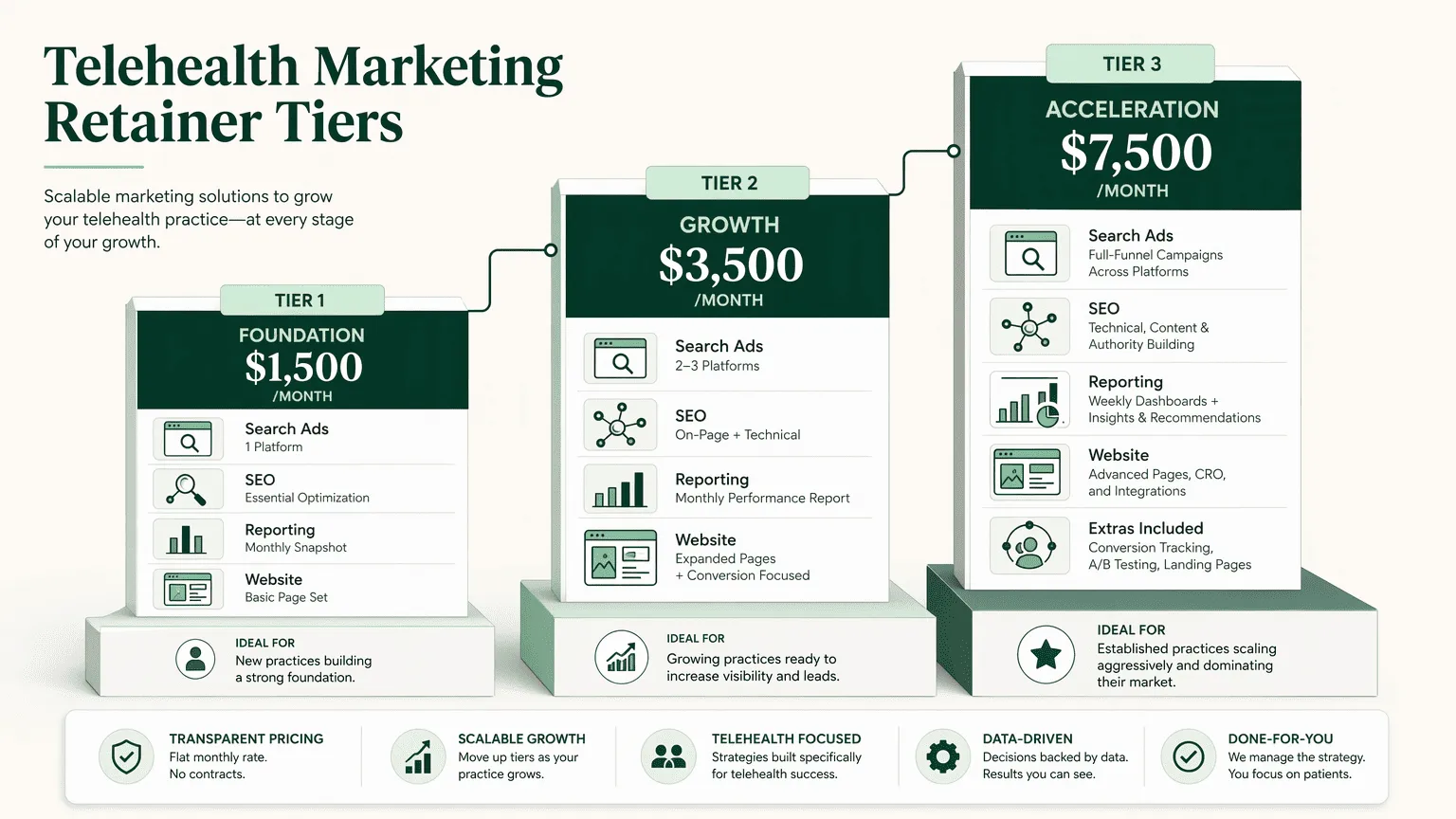
Below $2,500/mo, you are invisible. Most telehealth agencies in the US price monthly retainers from $5,000 to $25,000 and above, with project-based fees layered on for full website builds or major campaign launches. Here is what you can expect at each tier:
| Service Tier | Monthly Retainer Range | Typical Deliverables | Best For |
|---|---|---|---|
| Entry | $5,000, $8,000 | Managed paid search or social (one primary channel), basic SEO hygiene, monthly reporting. Often point-solution depth. | New DTC brands validating a single acquisition channel. |
| Mid-Market | $8,000, $15,000 | Multi-channel paid media, content and SEO programs, reputation management, conversion rate optimization, HIPAA audit on tracking. | Scaling virtual-first providers adding second and third channels. |
| Full-Funnel | $15,000, $25,000+ | Full paid search, social, programmatic oversight, thorough content engine, analytics infrastructure, pharmacy/DTC Rx integration, privacy-safe attribution rebuild. | Established hybrid brands or health systems treating telehealth as a core line of business. |
Project fees for a compliant telehealth website run $15,000 to $50,000 depending on complexity, while a campaign launch sprint can add $10,000 to $20,000. The spread reflects healthcare-specific design reqs, BAA-covered tech stacks, and the integration burden of pharmacy or payer systems, not just creative.
The Proven 6-Point Vetting Scorecard for US Practices
Most clinics hire a telehealth marketing agency the same way a retail brand does, and they pay in wasted budget and regulatory exposure for six to twelve months before they realize the brief was wrong. The fix is a provider-side scorecard that filters for specialization, not general agency credentials. Here is the framework we apply after evaluating agencies across four criteria: named telehealth client outcomes, regulatory fluency, full-funnel coverage, and market reputation.
- Healthcare experience depth: the agency must work across multiple medical subspecialties at the practice level. A firm like Intrepy Healthcare Marketing manages physician listings across more than 40 subspecialties, which is the baseline reference, ask for named telehealth brands with ROAS stories.
- If the rep cannot discuss server-side conversion APIs, remove them from the shortlist.
- Verifiable telehealth ROI case studies: demand attribution data for scheduled visits or prescription fills tied to campaigns. Cardinal Digital Marketing helped the country's largest mental health provider scale across 500+ locations, that kind of scale reference separates operators from theorists.
- DTC pharmacy or Rx integration capability: if you run an online pharmacy, the agency needs a dedicated program that connects media investment to prescription economics, not just top-of-funnel metrics.
- Cultural fit and transparency: reporting cadences must include incrementality tests and patient acquisition cost by condition category. Weekly dashboards that only show impressions signal a black box.
- Regulatory-forward mindset beyond HIPAA: agencies should acknowledge state wiretap laws, the FTC Health Breach Notification Rule, and platform policies on substance-advertising before you raise them.
What ROI Telehealth Providers Are Hitting in 2025 to 2026

US telehealth brands are seeing digital marketing ROI of 3:1 to 8:1 in 2025 to 2026, but that spread depends entirely on competition density and condition category. The providers at the 8:1 end are not running commoditized 'Book Now' campaigns, they are investing in brand storytelling that reduces the stigma barrier for high-value conditions and a localized SEO engine that feeds hybrid appointment models.
The GLP-1 weight-loss category illustrates the gap between average and top-decile performance. Sweat Pants Agency built the lifecycle program for a GLP-1 subscription brand that quadrupled email-attributed revenue, and they also reported a 9x revenue increase over 30 days for TrimRx through email and SMS (both results are self-reported and unverified). These numbers are not typical, but they demonstrate what happens when patient acquisition cost (PAC) management is wired into the retention stack.
Healthcare Success has documented approaches for navigating stigma while driving demand for brands in sensitive condition categories, and their work with SynergenX and OAR Health shows the pattern: condition-specific content reduces front-end PAC, while remarketing to existing patients increases lifetime value. The brands that hold a 6:1 to 8:1 ratio typically run separate strategies for stigmatized versus standard conditions, because a single blended campaign cannot serve both economics.
Expect your first three to six months to run at the lower end of the range while the agency dials audience signals, rebuilds attribution in a pixel-restricted environment, and fixes landing page conversion rates. The 3:1 floor is still profitable for most telehealth unit economics, but anything below that means either your agency is buying the wrong traffic or your attribution is broken, and post-Becerra, both possibilities are likely.
The 2026 Playbook: AI, Video, and Post-Becerra Attribution

AI-driven personalization is no longer a pitch-deck slide. Frontrunners now deploy machine learning models that score patient intent signals across search, social, and chatbot interactions, then route high-intent patients to condition-specific landing pages that adapt in real time. Platforms like ClinAds, a AI-first growth platform for healthcare practices, embed this logic directly into Google, ChatGPT, Gemini, and Perplexity distributions, the objective is discovery where the patient is, not where the media planner assumed.
The content engine is shifting to video-first. Telehealth brands that produce short-form condition-explainer videos, clinician-led Q&A, and patient-journey testimonials consistently outperform static display and generic search copy in trust benchmarks, especially for conditions with high considered-purchase timelines. The mechanism is simple: a 45-second clip of a provider explaining a treatment protocol builds credibility faster than a 1,000-word landing page, and platforms like TikTok and YouTube Shorts are now primary discovery channels for patients under 45.
Attribution modeling is being rebuilt from the ground up. With pixels prohibited on authenticated pages and cookie deprecation accelerating, agencies are migrating to server-side conversion APIs, incrementality holdout tests, and media mix modeling that does not rely on per-user identifiers.
Legal risk is also evolving. The Becerra ruling settled one question but opened others, as state wiretap claims and FTC enforcement actions under the Health Breach Notification Rule stack on top of HIPAA. In this environment, compliance is not a checklist item, it is a competitive moat for the brands that get it right and a kill shot for the ones that do not.
Conclusion
Telehealth marketing in 2026 rewards specificity. Generalist agencies that borrow healthcare vertical experience will keep burning budget and creating compliance risk. What works: a partner who understands virtual-first patient flows, rebuilds attribution in a pixel-restricted world, and builds creative around condition economics instead of generic direct-response playbooks. If your current agency's reporting still runs on standard pixel data and their BAA conversation never went past a one-line sales assurance, the gap between what you think you are buying and what is legally defensible costs more than the retainer. That gap is exactly what a specialized telehealth marketing agency closes.
Frequently Asked Questions
What services does a telehealth marketing agency provide?
A telehealth agency builds SEO, paid search, paid social, content, website, and reputation management programs tailored to virtual care. The output is scheduled visits, not leads. They often integrate DTC pharmacy components and measure success by patient acquisition cost and lifetime value, not impressions.
They remove tracking pixels from authenticated pages, patient portals, and symptom checkers, cookie banners are not enough. All vendors that touch PHI must sign business associate agreements. Attribution shifts to server-side APIs and incrementality testing that protect patient data.
What is the typical cost or pricing model for hiring a telehealth marketing agency?
Monthly retainers range from $5,000 to over $25,000. Entry tiers cover one paid channel and basic SEO, mid-market adds multi-channel and HIPAA audits, and full-funnel includes analytics infrastructure and pharmacy integration. Project fees for website builds add $15,000, $50,000.
What ROI can US telehealth providers expect from digital marketing in 2025 to 2026?
ROI benchmarks range from 3:1 to 8:1. Top performers invest in brand storytelling for stigmatized conditions and localized SEO for hybrid models. Lower ratios are still profitable, but sub-3:1 usually means broken attribution or poor traffic quality, especially post-Becerra.
What are the latest trends in telehealth marketing for 2026?
Three shifts dominate telehealth marketing in 2026:
- AI personalization scores patient intent signals and routes high-intent users to adaptive landing pages in real time.
- Video-first content replaces static formats for trust-building, especially on TikTok and YouTube Shorts for patients under 45.
- Post-Becerra attribution rebuilds use server-side APIs and media mix modeling to prove ROI without exposing protected health information.
Sources
- SEO & GEO Expert | Careers at ClinAds - getclinads.com
- Telehealth marketing agency for virtual first and hybrid care brands | Healthcare Success - healthcaresuccess.com
- 7 Best Telehealth Marketing Agencies (2026) | Top Agency Lists - topagencylists.com
- Best Telehealth Marketing Agencies (2026) | Sweat Pants Agency - www.sweatpantsagency.com
Want help executing this for your clinic?
Book a 30-minute call and we will map what a real ad engine would look like for your specific service mix.
Book a call