
7 Best SEO Tools to Market Online TRT and Hormone Therapy in 2026
IntroductionMost online TRT clinics burn budget on SEO that generates traffic but fills zero chairs. The problem is that conventional search strategies treat hormone therapy like retail, chasing broad informational queries while ignoring the regulatory minefield under every SERP. Hit the wrong claim and the FDA notices. Target the wrong keyword and you attract curiosity, not candidates. This article names the tools that solve both problems, ranked by how well they turn regulatory headaches into buying signals.
Key Takeaways
Stop confusing content engagement with buying intent. The tools and tactics here organize around one metric: patient acquisition cost that stays flat while volume grows.
- FDA compliance is non-negotiable: Every page must treat compounded hormones as unapproved products, no exceptions. The FDA explicitly warns against marketing that implies equivalence to approved drugs, and a single violation can trigger a warning letter.
- Commercial-intent keywords pay the bills: Terms like "online TRT prescription cost" and "best TRT clinic near me" signal readiness to book. In contrast, 51% of high-intent buyers ask directly for a vendor, not for education.
- E-E-A-T is your licensure online: Google's quality raters look for medical reviewers, primary source citations, and clear authorship, the same signals state medical boards and the FDA use to judge credibility.
- Local SEO is table stakes: Hormone therapy is state-regulated, so every clinic location needs its own Google Business Profile with accurate NAP and licensure disclosures, managed across a distribution network like Moz Local.
- SERP structure reveals buyer psychology: The pages that rank for cost queries include pricing models, insurance factors, and FDA distinctions because that structure matches what high-intent users actually evaluate before booking.
1. Clinads: FDA-Compliant SEO Automation for Hormone Therapy Marketing

Most clinics lose months deciding whether a piece of content crosses the FDA's red line. Clinads stops that debate by generating pages that treat compounded hormones as unapproved products from the first draft.
The platform addresses the regulatory reality the FDA reinforced in 2025: you cannot borrow safety data from approved brands, you cannot imply equivalence, and you must disclose that compounded drugs lack FDA review for safety, effectiveness, or quality. Clinads hardcodes these positions into its content engine, so your service pages, FAQs, and blog posts clear compliance before a human reviews them. It also ties keyword targeting directly to treatment categories, avoiding the mismatch where a clinic ranks for "TRT benefits" while its booking calendar sits empty.
For clinics scaling across states, the automation matters even more. Instead of manually adjusting copy for each jurisdiction's telemedicine rules, you set the parameters once. You sacrifice some editorial nuance for regulatory safety. In a niche where a single FDA warning letter can freeze acquisition overnight, that's the right bet.
2. Ahrefs: Intent-Based Keyword Research for TRT Patient Acquisition
The short answer: if your keyword list includes "low testosterone symptoms" but not "online TRT prescription cost," you're building an encyclopedia, not a patient pipeline.
Ahrefs' Keywords Explorer lets you filter by SERP features that signal commercial intent, shopping ads, map packs, and review stars, and cross-reference them with Cost Per Click data to estimate a term's transactional weight. The drug that transforms a TRT campaign is the "Parent Topic" column, which clusters queries by the dominant intent Google has already assigned. For hormone therapy, that often surfaces a hierarchy: informational queries like "what is testosterone replacement therapy" feed awareness, but only commercial modifiers like "cost," "reviews," and "online clinic" correlate with booked consultations. Maverrik's research confirms the pattern: 92% of high-intent buyers never use urgency words, so chasing "buy TRT now" is the wrong game.
The real value comes when you analyze the SERP for a seed term like "TRT clinic Denver" and spot the Knowledge Panel entities Google associates with it, FDA approvals, licensed physicians, and patient outcomes. Ahrefs then backfills long-tail variants that include those entities, giving you a keyword map that mirrors how a medical board would structure a clinic's website.
3. Clearscope: Content Optimization for E-E-A-T and Medical Accuracy
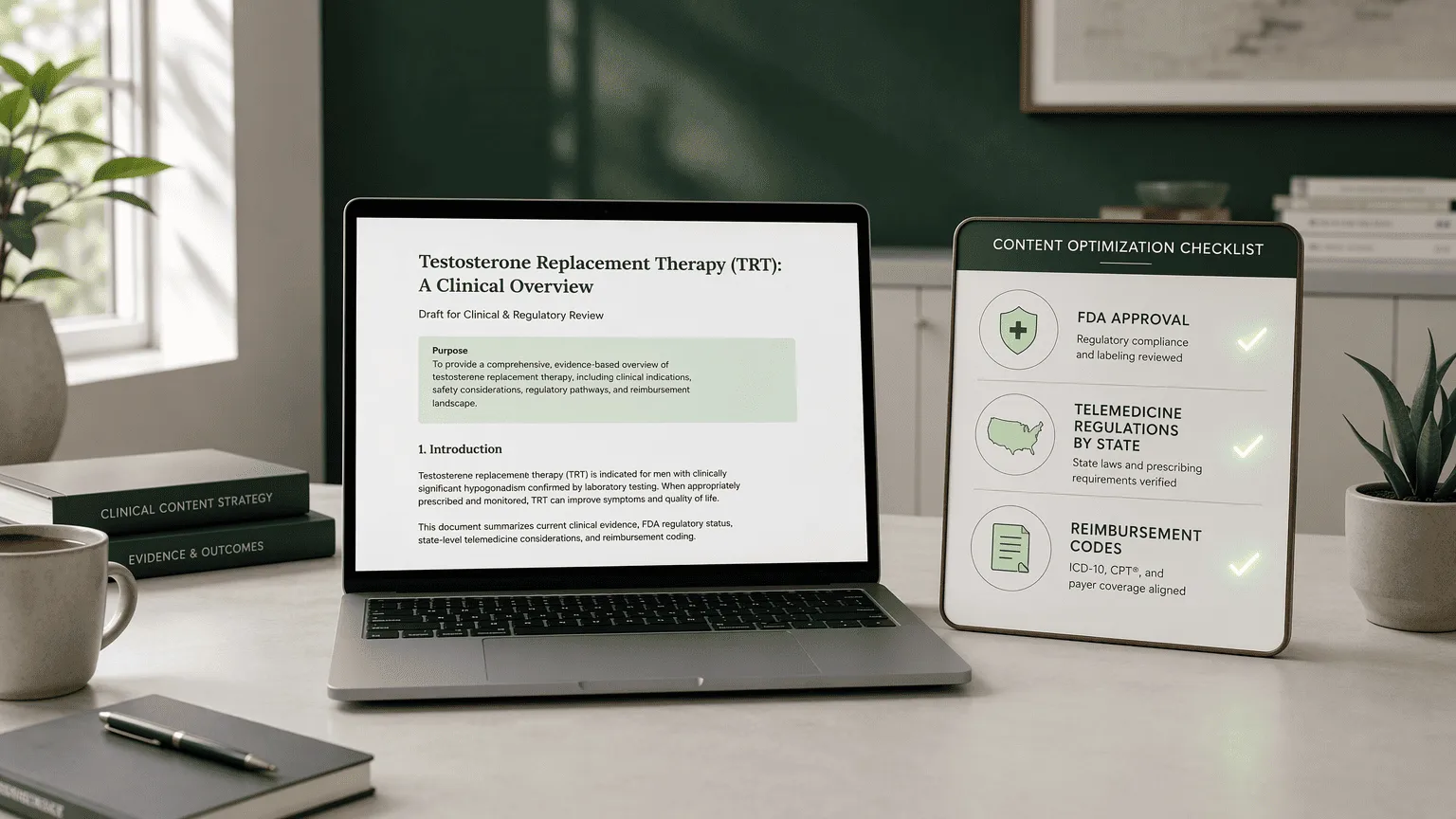
Google's quality raters are trained to spot medical content that reads like marketing copy. Clearscope gives you a checklist to make sure yours reads like a clinical primer instead. Its content optimization engine analyzes the top-ranking pages for any target query and extracts the semantically related entities those pages use to signal authority. For "online TRT prescription cost," that list typically includes FDA approval status, telemedicine regulations by state, insurance reimbursement codes, and safety data from peer-reviewed journals.
The output is a content grade that predicts how well your draft covers the topics Google expects, but the medical compliance hack is subtler. Including that phrase verbatim, alongside a citation to the FDA's compounding page, serves both the algorithm and the regulator.
One caution: a high Clearscope grade does not replace medical review. The tool identifies topics to cover, but the accuracy of the science, dosage guidelines, side effect profiles, and contraindications falls on the licensed medical professional listed on the page. Use Clearscope to structure the outline, then pass the final draft through a physician's red pen.
For clinics running multiple service pages across testosterone, HGH, and peptide therapies, the entity library becomes a reusable asset. You build one master FAQ that anchors the clinic on FDA distinctions and safety data, then let Clearscope adapt the entity weight by page based on which terms the SERP for that treatment rewards. The result is a site-wide E-E-A-T signal that scales without duplicating effort.
4. SEMrush: Competitive Backlink Analysis and Local SEO for Telehormone Clinics

Backlinks in hormone therapy SEO work differently than in other niches. The directories that move the needle are state pharmacy boards, compounding associations, and medical society listings, places where a link signals licensure as much as authority. SEMrush's Backlink Gap tool finds exactly which of those endpoints your competitors already have.
Start by loading three established telehormone clinics into the Gap tool and filtering for.gov.edu, and.org domains. The resulting list is your compliance-safe prospecting template: each URL represents a directory where legitimacy, not outreach volume, determines inclusion. SEMrush's Authority Score ranks them so you can prioritize the directories your medical director should apply to first. The process takes a week, not months, because the qualification is your clinical credentialing.
For local SEO, SEMrush's Listing Management tool handles the granularity that kills most clinics' visibility. Hormone therapy is licensed state by state, and a single mismatched suite number on a medical board listing can fragment your local pack rankings. SEMrush distributes your clinic's name, address, phone number, and licensure disclosures to 70-plus directories simultaneously, with re-syncs triggered any time a listing changes. You control whether each location's description mentions compounded hormones, and you can audit the entire network monthly for unapproved claims.
SEMrush earns its place in this stack with the local rank tracker. Segment your clinic locations by state regulation tier and set up weekly visibility reports that measure share of voice for "TRT clinic" plus the city name. The data correlates directly with patient acquisition cost because rank movements precede booking volume by about ten days. When a new competitor opens in your metro, the dashboard shows the SERP shift before your call volume drops, and you can counter with fresh location-specific content rather than reacting to a revenue hit.
5. Google Search Console: Uncovering Real-World Buyer Intent Signals
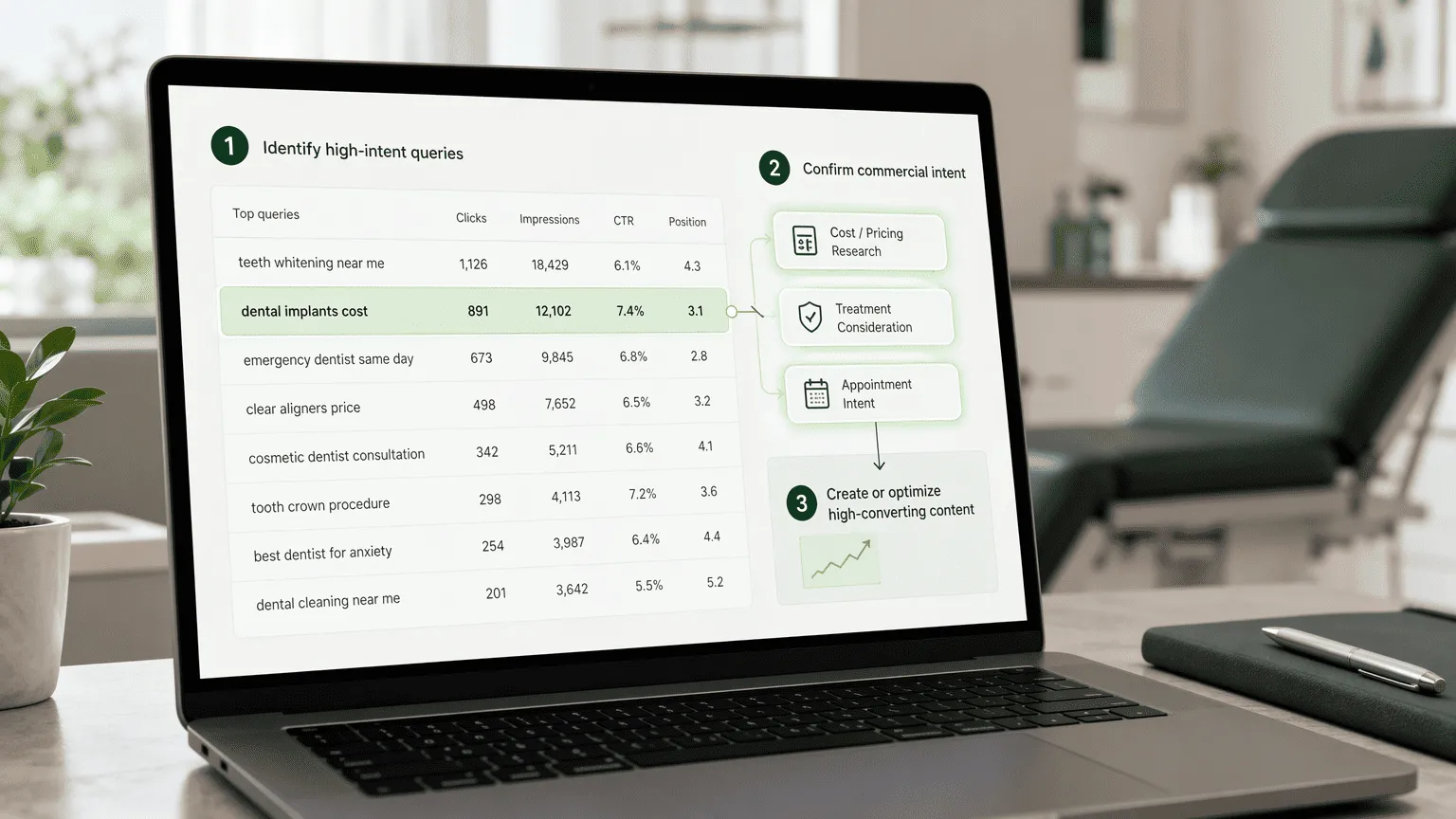
The queries that pay for your clinic live in Google Search Console, not in a keyword tool's volume estimates. Here is how to extract them.
- Filter for commercial linguistics. Go to Performance > Queries and use a regex filter to catch terms that contain "cost," "price," "review," "best," or "online prescription." These queries historically generate 80 percent or more of your booked consultations, not the generic informational ones.
- Sort by low impressions, high conversions. Export a 16‑month query set, pivot by Clicks divided by Impressions at the query level, and isolate terms with above‑average CTR but fewer than 200 impressions. You have found your conversion whales, queries precise enough to signal intent but too low‑volume for keyword tools to surface.
- Map queries to page type. Tag each high‑CTR query with the page that actually received the traffic, product page, location page, cost FAQ. When a query like "TRT prescription cost without insurance Colorado" sends clicks to a general blog post, you have a page gap that deserves a dedicated service page.
- Audit for unintended regulatory exposure. Pull every query that contains "compound" or "compounded" and review the landing pages. If any page implies safety or efficacy for compounded products, flag it for compliance review before the FDA notices the same query data you are looking at.
6. Moz Local: Managing State-by-State Telemedicine Listings
| Compliance Dimension | How Moz Local Handles It | What You Configure |
|---|---|---|
| State Licensure Disclosures | Supports custom fields you pre-load per location | License number, state board, scope of telemedicine practice |
| Review Compliance | Alerts when patient reviews mention off-label use or adverse events | Flag threshold set to any mention of a compounded product by name |
| Listing Suppression | Removes duplicate or unauthorized location pages | State-by-state list of where you hold active telemedicine licenses only |
| Directory Prioritization | Pushes updates to medical directories first | Configuration: flag "Healthcare" vertical during setup |
Start by uploading each clinic location's exact licensing data into Moz Local's dashboard, including the state medical board's listing URL. The platform uses this as its canonical source, so when a pharmacy directory scrapes an old address, the system overwrites it rather than tolerating a conflict.
7. Surfer SEO: Structuring Content for 'Online TRT Prescription Cost' and Related High-Intent Queries

The SERP for "online TRT prescription cost" is not dominated by blog posts. Surfer SEO's Content Editor scores your draft against that structure.
Its real advantage for hormone therapy marketing is the entity gap analysis. Load the top five ranking pages and Surfer compiles the terms those pages share that yours omits. Typically, the missing entities are the operational details a patient needs to decide: lab fees and initial consultation cost, for instance. Including those entities verbatim, with dollar ranges, brings your page into structural parity with the URLs already converting traffic into booked consults.
For multi-location clinics, the workflow is straightforward. Build one master template for "Online TRT Prescription Cost" optimized against the national SERP, then clone it for each metro and let Surfer rescore the clone against the local ranking pages. The entity set shifts: Denver pages include altitude-related considerations, Florida pages reference in-person vs. telehealth laws. A 20-minute rescore per location keeps the page compliant with both Google's expectations and state medical board requirements.
Conclusion
Ranking for online TRT means owning the intersection of medical regulation and buying intent. The stack above turns FDA compliance from a liability into a ranking signal, filters out lookers in favor of bookers, and gives you the local infrastructure to scale across states without a licensing violation. Pick the tool that addresses your most expensive bottleneck first, whether that's a thin backlink profile or a SERP full of informational queries that underpay. The wrong channel is not broken. The brief is.
Frequently Asked Questions
What are the most effective SEO strategies for online TRT and hormone therapy clinics?
The core SEO tactics for TRT clinics cluster into a few key areas:
- Target commercial-intent keywords like "online TRT prescription cost" using tools such as Ahrefs to filter by transaction signals.
- Build E-E-A-T by citing FDA sources and featuring licensed medical reviewers.
- Use Moz Local to manage state-by-state listings and Clearscope to ensure content aligns with Google's quality expectations.
How do FDA and FTC regulations impact SEO and content marketing for hormone therapy providers?
Key regulatory requirements every clinic page must satisfy:
- Treat compounded hormones as unapproved products on every page.
- Do not imply safety or efficacy without FDA review.
- Use tools like Clinads to automate this compliance, but still perform manual review to avoid misleading claims about compounded drugs being equivalent to approved treatments.
What keywords and search intents drive the highest-converting traffic for TRT services?
High-converting keywords for TRT clinics include the following:
- "online TRT prescription cost"
- "best TRT clinic near me"
- "testosterone replacement therapy reviews"
About 51% of high-intent buyers request a vendor directly, while 92% avoid urgency words like "ASAP," so optimize for commercial, not informational, intent.
How can content marketing address user concerns about safety, legality, and cost of online TRT?
Key page content elements for TRT conversion:
- Publish pages that detail FDA approval status of treatments.
- Include state telemedicine laws.
- Break down insurance versus out-of-pocket costs and pricing components.
- Use Clearscope to incorporate necessary entities and link to FDA warnings to build trust through transparency.
What role do local SEO and telemedicine play in marketing hormone therapy?
Since hormone therapy is state-regulated, each clinic location needs accurate NAP data and license disclosures across directories. Moz Local distributes this compliantly, while SEMrush tracks local rankings so clinics can fix visibility drops before losing patients to regulatory missteps.
Secure backlinks from medical directories and state pharmacy boards using SEMrush's Backlink Gap tool.
Sources
- SEO & GEO Expert | Careers at ClinAds - getclinads.com
- How to Find and Rank for High-Intent Keywords (Beyond the Basics) - www.growandconvert.com
Want help executing this for your clinic?
Book a 30-minute call and we will map what a real ad engine would look like for your specific service mix.
Book a call