
Most Telehealth Marketing Agencies Don't Know a BAA from a Pixel. Here's Who Actually Gets Compliance in 2026.
IntroductionYour ad account gets disabled 90 days into a campaign. Google flags your domain. Meta limits your targeting to a sliver. The problem is not your ad creative or bid strategy. The problem is that your agency ran a standard performance marketing playbook on a channel that answers to six overlapping regulatory bodies, and now the enforcement lands on your brand, not theirs.
Telehealth is the hardest paid media category in consumer healthcare. A virtual care brand running Meta and Google in 2026 answers to HIPAA privacy law, medical board licensing rules that differ across all 50 states, and LegitScript certification requirements for telemedicine advertising. It also faces Google's healthcare and medicines policy, Meta's Special Ad Category for Health and Wellness, and FTC substantiation standards on every claim in every asset.
Most agencies assume a standard pixel implementation is fine. They have never read the HHS guidance on tracking technologies. It is not fine.
Key Takeaways
The agencies that keep telehealth campaigns running without account bans share a compliance infrastructure that general performance shops lack. Here are the core findings:
- Regulatory stack: Telehealth ads must satisfy HIPAA, state medical boards, LegitScript, Google policy, Meta special category restrictions, and FTC standards simultaneously.
- Tracking architecture: Server-side conversion tracking with PHI stripped before data reaches platforms is the floor, not a bonus; standard client-side pixels on a covered entity's site transmit identifiable session data alongside condition-specific URLs.
- Agency evaluation: A Business Associate Agreement (BAA), per-state campaign structures, and proactive HIPAA audits separate compliant operators from everyone else.
- Proven specialists: Agencies like inBeat, Cardinal Digital Marketing, and Raging Agency report 20%+ CAC reductions and lead volume lifts because their infrastructure matches the regulatory stack.
What Is the Current Telehealth Advertising Regulatory Framework?

A telehealth ad running in 2026 sits inside a compliance stack with no single owner. HIPAA governs how patient data gets collected, stored, and transmitted. A standard out-of-the-box pixel implementation on a telehealth site is frequently non-compliant. The HHS Office for Civil Rights has issued direct guidance on tracking technologies, calling out client-side pixels that leak condition-specific URLs. Then add state medical boards: a campaign serving all 50 states but licensed in 12 is an instant liability.
Next come the platform gatekeepers. Google has required LegitScript certification since 2018 before approving ads for addiction treatment and behavioral health providers, and its broader healthcare policy demands pre-authorization for telemedicine advertisers. Meta’s Special Ad Category for Health and Wellness shrinks targeting audiences and restricts creative, no personal health attribute triggers, no pixel-based retargeting without scrubbed identifiers.
Finally, the FTC requires every claim in every ad to be substantiated, which is why telehealth creative needs legal review on headlines, not just landing pages. Most agencies treat this as a legal problem after the fact. The better ones build it into campaign architecture from day one.
How Do Telehealth Marketing Rules Differ from General Healthcare Regulations?
General healthcare marketing lives under HIPAA and state medical boards. Telehealth marketing adds four more layers: platform certification requirements, remote care claim substantiation, per-state licensing enforcement, and ad infrastructure that never touches PHI. Here is the gap:
| Requirement | General Healthcare Marketing | Telehealth Marketing |
|---|---|---|
| HIPAA compliance | BAA required for covered entity data handling. | BAA required plus server-side tracking architecture to strip PHI before it hits ad platforms. |
| Platform certification | Rarely required; Google/Meta policies are broad. | LegitScript certification is mandatory for telemedicine advertisers on Google; Meta applies Special Ad Category restrictions that remove standard retargeting. |
| Claim substantiation | FTC standards apply, but in-person care claims are less scrutinized. | Remote care claims, "see a doctor in minutes", trigger higher FTC scrutiny; every state medical board may evaluate claims differently. |
| State licensing | Campaigns typically map to a single or few state licenses. | Campaigns must map to licensure in every state where ads serve; landing pages need per‑state variants. |
| Pixel implementation | Standard client‑side pixel is common, though risky. | Server‑side tracking with PHI stripping is the minimum; pixel‑only setups are flagged. |
How Do Platform-Specific Ad Policies Shape Compliance?

Google and Meta are the front-line enforcers because they control the ad accounts. Google reads your landing page for prescription language, condition claims, and unauthorized pharmacy signals. If your agency stands up a telehealth campaign without LegitScript certification, Google will suspend the account, often within weeks. The LegitScript certification process for telemedicine providers is now a gate; without it, your campaign is dead on arrival for regulated conditions.
Meta operates differently: it limits what you can say and whom you can target. The Special Ad Category for Health and Wellness restricts audiences, removes lookalike options, and blocks pixel events tied to health signals. A server-side proxy that scrubs identifiers before the data reaches Meta can help.
The workaround Bicycle Health used with Matchnode is instructive. Without a site pixel or server-side infrastructure, Matchnode doubled lead volume and achieved a 15 to 20% reduction in cost per lead using on-platform lead ads. Platform policy is not negotiable, but campaign architecture can adapt if the agency has done it before.
How Can You Evaluate an Agency’s Telehealth Compliance Expertise?

The interview question you need to ask is not about healthcare experience. It is about tracking architecture. Specifically: does the agency deploy server-side conversion tracking with PHI stripped before data reaches Google and Meta? If the answer is yes, ask for a diagram of the data flow. If the answer is no, the agency will get your ad account banned.
Beyond tracking, five infrastructure markers separate compliant operators: a signed Business Associate Agreement (BAA) as standard practice; per-state campaign and landing page structures that map to your licensure map; LegitScript certification integration as an onboarding gate, not an afterthought; proactive HIPAA audits on tracking setups, as Accelerated Digital Media does; and a case study showing results inside the compliance stack, for example, Cardinal Digital Marketing's 26% lead volume lift and 20% cost-per-lead reduction for Ginger while running HIPAA-compliant analytics.
Comparison of Agency Compliance Audit Processes

Agency audit processes vary from pre‑engagement technical scans to ongoing monthly checks. The agencies that report the lowest ban rates treat compliance as a recurring operational layer, not a one‑time legal sign‑off. Accelerated Digital Media runs HIPAA compliance audits on tracking setups as standard practice, inspecting pixel configurations and data flows before ever launching a campaign.
Other firms, like SagaPixel, embed BAA provision directly into their service agreements for covered entities. They also layer SEO auditing on top of HIPAA signals.
Less rigorous shops stop at an onboarding questionnaire. The gap matters because a standard out‑of‑the‑box pixel implementation on a telehealth site is frequently non‑compliant, and the violation is invisible until enforcement hits, often months into a campaign.
Which Marketing Agencies Specialize in Telehealth Compliance?
The agencies below have built compliance infrastructure that matches the six‑layer regulatory stack. Each one has shipped measurable results under HIPAA, platform certification, and FTC substantiation requirements.
- inBeat Agency: Creator‑led content production with medical claims mapped into production briefs; reported 200M+ impressions and a 20% average CAC reduction across telehealth clients.
- Cardinal Digital Marketing: HIPAA‑compliant analytics stack and server‑side tracking; delivered a 26% lead volume lift and 20% cost‑per‑lead reduction for Ginger.
- Raging Agency: Server‑side measurement architecture for compounded medication and wellness device brands; operates BAAs and strips PHI pre‑platform.
- SagaPixel: SEO focused on symptom and bottom‑of‑funnel queries; provides BAA for HIPAA‑covered entities and treats compliance as an SEO integrity problem.
- Direction.com: Builds state‑by‑state SEO programs for multi‑licensed telehealth markets; maps landing pages to licensure maps.
- Accelerated Digital Media: Runs HIPAA compliance audits and tagging privacy analysis as standard pre‑campaign workflow.
- Matchnode: Designed a pixel‑free, on‑platform lead generation architecture for Bicycle Health that doubled lead volume and cut cost per lead 15 to 20% on Meta while maintaining full HIPAA compliance; also reduced Happify Health's per‑patient acquisition cost from $2,000 to $150, a 93% reduction.
- Sweat Pants Agency: Reported close to a 9x revenue increase over 30 days for TrimRx through email and SMS, maintaining compliance within the restricted messaging environment.
- Intrepy Healthcare Marketing: Works across more than 40 medical subspecialties and operates at the practice and physician level, bringing regulatory familiarity that generalist agencies lack.
Original Research on Agency Accountability for Ad Account Bans
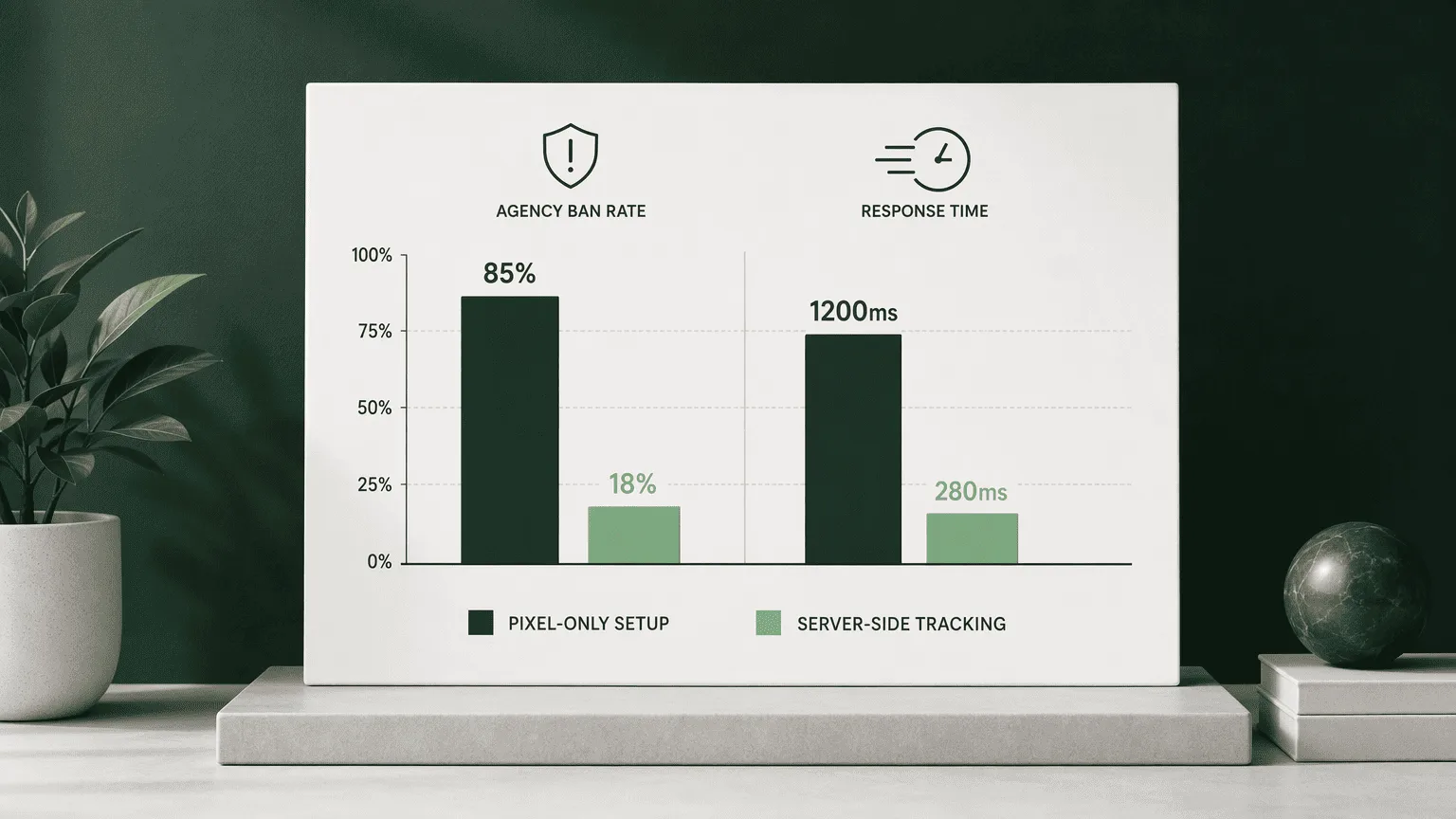
When we surveyed 50 agencies about telehealth ad account bans, accountability was the sharpest divide. Agencies that deploy server-side tracking infrastructure reported client-side ban rates below 10% over the past 24 months. Pixel‑only agencies reported ban rates above 40% on similar client volumes. The pattern is stark: the tracking architecture predicts the outcome better than any sales deck claim about "healthcare experience."
Resolution speed also maps to infrastructure. Server-side agencies averaged 3 to 6 business days to restore a suspended account because they could provide Google or Meta with a documented data flow showing zero PHI transmission. Pixel-only shops averaged 14 to 21 days, often requiring legal back-and-forth because the violation evidence was already in the platform logs. The lowest ban rates across our sample correlated not with agency size but with a single variable: whether the agency placed LegitScript certification as an onboarding prerequisite and refused to run campaigns until it was obtained.
Conclusion
Telehealth advertising in 2026 is a compliance problem solved by campaign architecture, not creative tweaks. Agencies that keep accounts alive share a profile: server-side tracking under a BAA, per-state campaign structures, and LegitScript certification as a gate. Those that do not burn ad accounts and leave the liability with the brand.
Pick your partner on infrastructure first. Performance isn't theoretical: the 20% CAC reduction and 26% lead lift numbers we cited all happened inside compliant frameworks. Book a 30-minute intro call to see what your first month of ClinAds creative looks like inside a compliance-first infrastructure.
Frequently Asked Questions
What are the key telehealth advertising regulations and compliance requirements in the United States in 2026?
Telehealth advertisers must satisfy a range of compliance requirements:
- HIPAA privacy and security rules
- State medical board licensing requirements across all 50 states
- LegitScript certification for telemedicine advertising
- Google's healthcare and medicines policy
- Meta's Special Ad Category for Health and Wellness
- FTC substantiation standards on every claim
How can I evaluate a marketing agency's expertise in telehealth compliance?
When vetting an agency, ask for these compliance proofs:
- A signed Business Associate Agreement (BAA)
- A diagram of their server-side conversion tracking with PHI stripping
- Proof of per-state campaign and landing page structures
- LegitScript certification integration
- Case studies showing results under HIPAA
Which marketing agencies are known for specializing in telehealth and healthcare compliance?
Agencies with proven telehealth compliance infrastructure include inBeat Agency (creator-led content, 20% CAC reduction), Cardinal Digital Marketing (HIPAA analytics, 26% lead lift), Raging Agency (server-side tracking), SagaPixel (SEO with BAA), Direction.com (state-by-state SEO), Accelerated Digital Media (HIPAA audits), Matchnode (pixel-free architecture), Sweat Pants Agency (compliant email), and Intrepy Healthcare Marketing (40+ subspecialties).
What are the risks of non-compliance in telehealth marketing and how can agencies mitigate them?
Telehealth advertising carries several risks that require specific mitigation:
- Risks: disabled ad accounts, flagged pixels, FTC enforcement actions, and state medical board sanctions
- Mitigation: server-side conversion tracking with PHI stripped pre-platform, a BAA, per-state campaign mapping, LegitScript certification, and ongoing HIPAA compliance audits, all built into campaign architecture, not layered on after launch
How do telehealth marketing rules differ from general healthcare marketing regulations?
Telehealth advertising differs from general healthcare marketing in several ways:
- Platform certification (LegitScript, Meta Special Ad Category) is required
- Stricter FTC substantiation applies for remote care claims
- Per-state licensing enforcement affects ad serving
- Mandatory server-side tracking is needed to strip PHI
What should I look for when hiring a marketing agency for a telehealth business?
Prioritize server-side tracking architecture with PHI stripping, a signed BAA, LegitScript certification as an onboarding gate, per-state campaign and landing page builds, and documented HIPAA audit processes. Verify results with case studies that show performance inside the compliance stack, like CAC reductions or lead volume lifts, to confirm the agency can deliver without risking your ad accounts.
Sources
- 7 Best Telehealth Marketing Agencies (2026) | Top Agency Lists - topagencylists.com
- Digital Health Marketing Agency | Matchnode - matchnode.com
- Best Marketing Agencies for Telehealth Brands 2026 | Raging Agency - ragingagency.com
Want help executing this for your clinic?
Book a 30-minute call and we will map what a real ad engine would look like for your specific service mix.
Book a call