
How to Fill a Telehealth Weight Loss Program Without Emptying Your Ad Budget
IntroductionAd platforms actively throttle weight loss campaigns. Health and weight categories carry additional policy scrutiny, personalization limits, and disapproval risk. Yet clinics burn through cash anyway. Most clinics launch with media spend as the only growth lever while ignoring the free, compliance-safe channels that established brands use to fill their pipeline first.
This guide is a diagnostic and a prescription. It unpacks the organic acquisition playbook that works right now: content, referrals, reviews, communities, employer channels, regulatory positioning, and the few metrics that tell you whether any of it is actually working. No budget theater. Just the operational moves that get patients into the funnel before you ever touch an ad platform.
Key Takeaways
The low-cost patient engine is a stack of reinforcing organic levers that compound when you build them in order. Here is how each piece fits.
- SEO-first clinical content: Clinician-authored articles that rank for high-intent terms like "cost of GLP-1s" drive sustainable traffic without paid media.
- Referral partnerships: Brick-and-mortar physicians, endocrinologists, and dietitians are a zero-CAC channel if you arm them with a credible clinical profile.
- Compliant social proof: Patient reviews and testimonials, displayed without efficacy claims, convert visitors who arrive through organic search.
- Community authority: Participation in Reddit and Facebook groups, plus linkable price and transparency indexes, builds backlinks and trust simultaneously.
- Employer benefit integration: Getting listed in self-pay provider networks and employer wellness portals opens a B2B patient volume channel.
- Regulatory hygiene: Marketing that blurs the line between educational content and prescribing guidance invites FDA enforcement. More than 30 telehealth companies have already received warning letters.
Step 1: Build a Clinically-Grounded, SEO-Optimized Content Engine

Your website is an organic acquisition machine. It works only if it answers the exact queries patients type when they are already shopping for a solution. Google's AI Overviews and search agents now synthesize responses from trusted sources. If your site lacks clinical authority signals, it will not appear in the answer set.
Produce articles under a named, licensed clinician, exactly the pattern established by Hims & Hers and Ro. Target high-intent search terms like "cost of GLP-1s" or "compounded vs branded semaglutide." Every piece must visibly separate educational content from prescribing guidance.
Schema markup, particularly FAQ schema, makes your content quotable by AI engines and earns placement in featured snippets. The FDA's online content makes one thing clear: compounded drugs are not FDA-approved, the agency does not review them for safety, effectiveness, or quality before they are marketed, and their use should be limited to patients whose needs cannot be met by an FDA-approved drug. If your content blurs that distinction, you are building a liability and losing rankings.
Step 2: Forge Referral Partnerships with Brick-and-Mortar Clinicians
A primary care physician who tells a patient, “You should try X telehealth program,” generates a lead that converts at multiples of a cold organic visitor. The problem is that most telehealth startups pitch local doctors with a sales deck instead of a clinical handshake. What we’d recommend if you’re starting now: approach endocrinologists, PCPs, and registered dietitians with a one-page clinical profile that names your supervising physician, lists your formulary (with clear distinctions between branded and compounded), and outlines exactly how the handoff works, intake, follow-up schedule, clinical documentation shared back to the referrer.
Incentives must exclude cash-per-head kickbacks, which violate the Anti-Kickback Statute. Acceptable models include co-branded patient education materials, free continuing education sessions, or a streamlined electronic referral path that saves staff time. A clinic that sends you five verifiable referral patients in a quarter earns a named profile page on your site as a “trusted referral partner.” That costs nothing and builds mutual authority.
Step 3: Harness Patient Reviews and Testimonials for Social Proof

Ad platforms throttle weight loss ads, but reviews do not get throttled. A prospective patient who lands on your site after searching “virtual weight loss program reviews” makes a decision in seconds. Twenty or more detailed, recent reviews often decide whether someone books a consultation or hits the back button.
Collect reviews aggressively through automated post-consultation emails and SMS, targeting a steady flow rather than one push. Ask for specifics: how the intake felt, whether communication was clear, what the clinician’s manner was like. Reviews that stick to real experience details and avoid generic praise convert far better.
Compliance is the tightrope. The FDA’s enforcement framework is no longer theoretical. Any patient testimonial that states, implies, or suggests that compounded semaglutide is safe, effective, or equivalent to an approved drug creates exposure.
Your site must strip out efficacy language from every testimonial. Footer disclaimers are insufficient; the review itself cannot contain the claim. A review that says “I lost 20 pounds in two months on compounded semaglutide” is a liability.
One that says “Clinician Jane listened to my history and explained the treatment options clearly” is a conversion asset. The distinction is operational and enforceable.
Third-party review platforms like Google Business Profile and Healthgrades add a layer of perceived objectivity that your own site cannot replicate. List your program on major healthcare review directories and direct satisfied patients there. The goal is a search landscape where your brand owns the first page with your site, third-party profiles, and earned press, creating a trust perimeter that converts without paid clicks.
Step 4: Engage Online Communities and Create Linkable Assets

Reddit and condition-specific Facebook groups are where weight loss patients compare programs, ask about side effects, and share pricing data. The organic playbook is straightforward: stop lurking and start contributing as a named expert. Use a clinician profile, real name, photo, credentials, to answer medical questions in communities like r/Semaglutide, r/WegovyWeightLoss, or broader obesity support groups.
Every answer must adhere to a strict educational boundary. The clinician explains how these drugs work, describes the clinical trial data, and clarifies the regulatory status of compounded formulations. They avoid recommending your clinic, promoting your pricing, or offering medical advice.
Over time, the username becomes a recognized signal, and DMs become the conversion path. Patients ask where you practice. You respond with a link to your program page.
The real compounding value lies in building linkable assets that these communities and journalists will reference without being asked. Two assets stand out. A transparency index comparing pricing, compounding pharmacy partners, and clinical oversight across major telehealth providers is an evergreen SEO magnet. Updated quarterly, it earns backlinks from journalists writing about the weight loss industry, finance bloggers tracking DTC healthcare, and other clinic owners sizing up the competition. A side-by-side price index showing cash-pay costs for branded versus compounded GLP-1s, with dates and clear disclaimers, serves the same function.
These assets are labor-intensive to build but cost nothing to distribute once published. They signal to search engines and human evaluators that your clinic discloses real data.
Step 5: Integrate with Employer Benefits and Cash-Pay Strategies
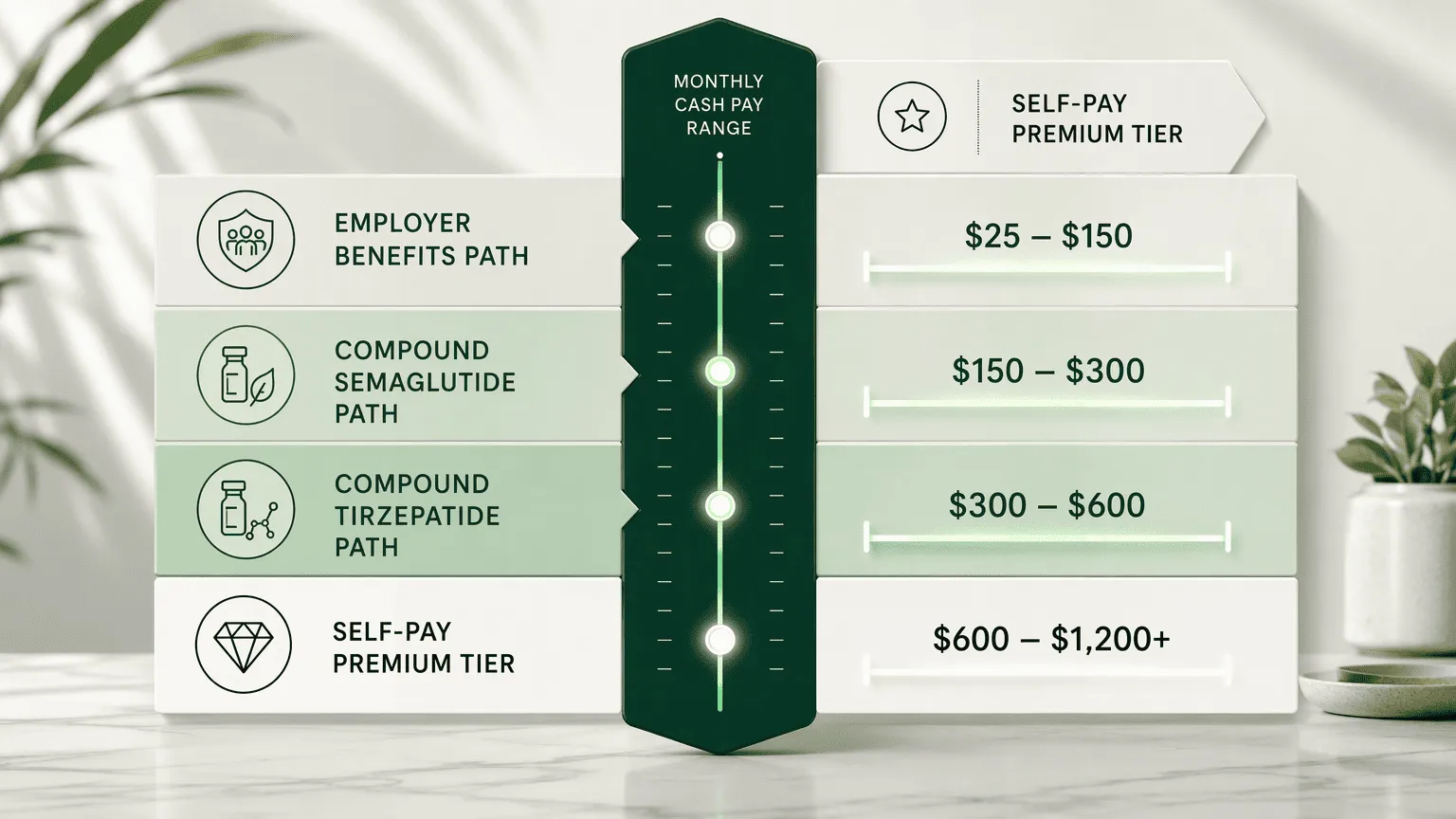
A large, motivated segment pays the full cost of GLP-1 drugs in cash even though they have insurance. About 27% of insured GLP-1 users pay out of pocket, per KFF’s Health Tracking Poll. These patients are your audience regardless of any payer contract.
Design transparent, cash-pay packages that fall within the market range. Compound semaglutide cash-pay monthly prices run $39 to $249, and compound tirzepatide costs $86 to $299 across major telehealth programs. Branded self-pay options sit at a different tier, Zepbound KwikPen runs $299 to $449, and the Wegovy pen is $349. Label each option on your pricing page clearly: drug name, compounded or branded status, and the services included.
Beyond direct-to-patient pricing, two other channels, self-pay provider networks and employer wellness portals, bring in patient volume without triggering ad platform restrictions.
| Channel | Patient Source | Cost to Clinic | Listing Process | Conversion Dynamics | Regulatory Edge |
|---|---|---|---|---|---|
| Self-Pay Provider Networks (e.g., Beyond Med Plans) | Consumers searching a member-facing directory for weight loss providers | Typically a 20% discount off standard pricing on provider service fees; no enrollment or monthly fee | Apply, agree to a discounted member rate for consultations and visits, maintain an active directory listing | Patients are pre-qualified as self-pay; purchase decision is price- and experience-driven | Network acts as a neutral router; does not set medication prices or make claims about drugs |
| Employer Wellness Portals | Employees and dependents of companies that have added your program as a voluntary benefit | Variable; often structured as a per-employee-per-month fee or an administrative fee on each visit | Negotiate directly with employer benefits managers or through a benefits broker; provide program documentation and pricing tiers | High-trust lead; employee sees your program as a vetted, endorsed benefit | Employer context defers to established benefits communication rules; claims stay within plan documents |
Step 6: Navigate Legal and Regulatory Compliance Confidently
Compounded tirzepatide and compounded semaglutide are not FDA-approved. The agency does not review them for safety, effectiveness, or quality before they are sold, a position clearly outlined in its enforcement materials. Marketing that blurs the distinction between approved and compounded products is the primary trigger for warning letters, and the FDA has already issued them to over 30 telehealth companies. As of November 20, 2026, the FDA has proposed excluding semaglutide, tirzepatide, and liraglutide from the 503B Bulks List, which would functionally end large-scale GLP-1 compounding.
Your marketing copy must state, without equivocation, whether your program offers branded medications, compounded formulations, or both. Every page that mentions pricing or clinical outcomes needs a conspicuously placed disclaimer: “Compounded drugs are not FDA-reviewed for safety, effectiveness, or quality.” The telehealth operating framework itself sits on a time-limited legal footing; federal telemedicine flexibilities for controlled substances run through December 31, 2026, with a permanent framework still pending. This does not directly govern GLP-1 prescribing, but it signals the regulatory temperature.
The safest structural move is to form a professional corporation with a supervising physician and have healthcare counsel review your structure before you commit to advertising, clinical contracts, or patient enrollment. Forming an LLC does not authorize a company to practice medicine. In regulated healthcare, entrepreneurial enthusiasm that skips the legal gear check is the fastest way to an enforcement action.
Step 7: Measure What Matters: Startup-Specific Acquisition Metrics

Below $2,500 per month in media spend, you are invisible. Without that spend, you track what actually matters. Organic patient acquisition metrics for a cash-strapped telehealth launch must answer one question: are we building a repeatable growth engine or just getting lucky? Here is the lightweight measurement stack to install from day one:
- Organic traffic to the consultation booking page: Track this as a standalone metric in Google Analytics (or a privacy-focused alternative). Segment by landing page, particularly the pricing page, the about/clinician page, and the FAQ schema-equipped articles.
- Consultation-to-booked rate: Divide completed consultation bookings by unique visitors to the booking page each week. A rate below 2% usually signals a gap between the content promise and the reality of the program.
- Referral source tagging: Assign a UTM parameter or source code to every external lever: physician referral emails (source=mdreferral), Reddit profile links (source=reddit), and employer portal listings (source=employer-bens). Track each source’s cost per acquisition, even at zero ad spend, time is the cost.
- Average revenue per patient by acquisition channel: Weight loss patients who come through physician referrals tend to have higher lifetime values than organic search visitors. Verify this assumption quarterly, then reallocate your clinical partnership time accordingly.
- Review velocity and sentiment: Count new reviews posted per week across all platforms. A negative slope over three consecutive weeks is an early warning that your service experience is degrading, which will tank organic conversion before any metric catches it.
Conclusion
The telehealth companies that survive 2027 will not be the ones with the biggest ad budgets. They will be the ones that built a trusted referral network and a content engine that answers patient questions before the consult. They will also have a legal framework that stays clear of FDA scrutiny.
Pick one step. Start with clinician-authored content and schema markup if your website lacks them. Stack the channels in sequence and measure what actually brings patients in. Treat compliance as your edge in acquisition.
Every touchpoint either builds trust or burns it. A site that loads slowly, a form that asks too much, a phone line that rings to voicemail: each one is the difference between a consultation booking and a back-button exit. Optimize for speed and reduce friction in intake forms. Your whole team needs to know they are part of the patient journey, not a sales script.
Want to see what a full organic-acquisition audit for a new weight loss program looks like? Book a 30-minute intro call with ClinAds.
Frequently Asked Questions
What are the most effective free or low-cost marketing strategies for a new telehealth weight loss program in the US?
Clinician-authored SEO content, physician referral partnerships, and compliant patient reviews are the core zero-spend levers. Create linkable price indexes, engage in Reddit health communities under a named expert profile, and get listed in self-pay provider networks.
How can I use healthcare professional referrals to grow my telehealth weight loss patient base?
Build a one-page clinical profile listing your supervising physician, formulary status, and referral workflow. Share it with local PCPs, endocrinologists, and dietitians. Offer co-branded education materials rather than cash incentives, which risk Anti-Kickback Statute violations.
What role do patient reviews and testimonials play in attracting new patients to a telehealth service?
Reviews convert organic visitors who are comparing programs. Collect them systematically via post-consultation follow-ups. Strip any language implying compounded drug efficacy; FDA enforcement targets testimonials that state or suggest safety or weight loss results from unapproved products.
What online platforms and communities are best for promoting a telehealth weight loss program organically?
Reddit communities (r/Semaglutide, r/WegovyWeightLoss) and condition-specific Facebook groups are high-intent hubs. Participate as a named clinician answering educational questions, not promoting your clinic. Over time, DMs from inquiring patients become a conversion path.
How can I use content marketing and SEO to attract patients to a telehealth weight loss program without paid ads?
Publish clinician-authored articles targeting queries like 'cost of GLP-1s.' Use FAQ schema for AI search snippets. Build price comparison and transparency indexes that earn journalistic backlinks. Clearly separate educational content from prescribing claims to maintain FDA compliance.
What are the key legal and regulatory considerations for marketing a telehealth weight loss program in the US?
Never imply compounded drugs are FDA-approved or equivalent to branded versions. The FDA has issued warning letters to over 30 telehealth companies. Each marketing page must carry a disclaimer: compounded drugs are not reviewed for safety, effectiveness, or quality. Form a professional corporation, not an LLC alone, and have healthcare counsel review all commercial copy.
Sources
- How GLP-1 and Weight-Loss Clinics Get New Patients Without Paid Ads - Beyond Med Plans - www.beyondmedplans.com
- How to Start a Weight Loss Clinic: Telehealth Founder's Guide - bask.health
Want help executing this for your clinic?
Book a 30-minute call and we will map what a real ad engine would look like for your specific service mix.
Book a call